 An indie-folk musical that reworks Georg Büchner's unfinished Woyzeck and promotes Marie to equal billing opens at Charing Cross Theatre in September, with Brenock O'Connor and Jade Oswald at the head of a company of 14 actor-musicians. Here is everything you need to know before you book.
Few musicals reach the West End by way of Seoul, but Franz & Marie has taken an unusually long road to Charing Cross Theatre. Commissioned two decades ago, first staged in South Korea, and written by two members of a Medway folk band, it arrives in London this September in a newly adapted version that changes where the story's weight falls. Here is what is worth knowing before it opens.
Who is starring in Franz & Marie?
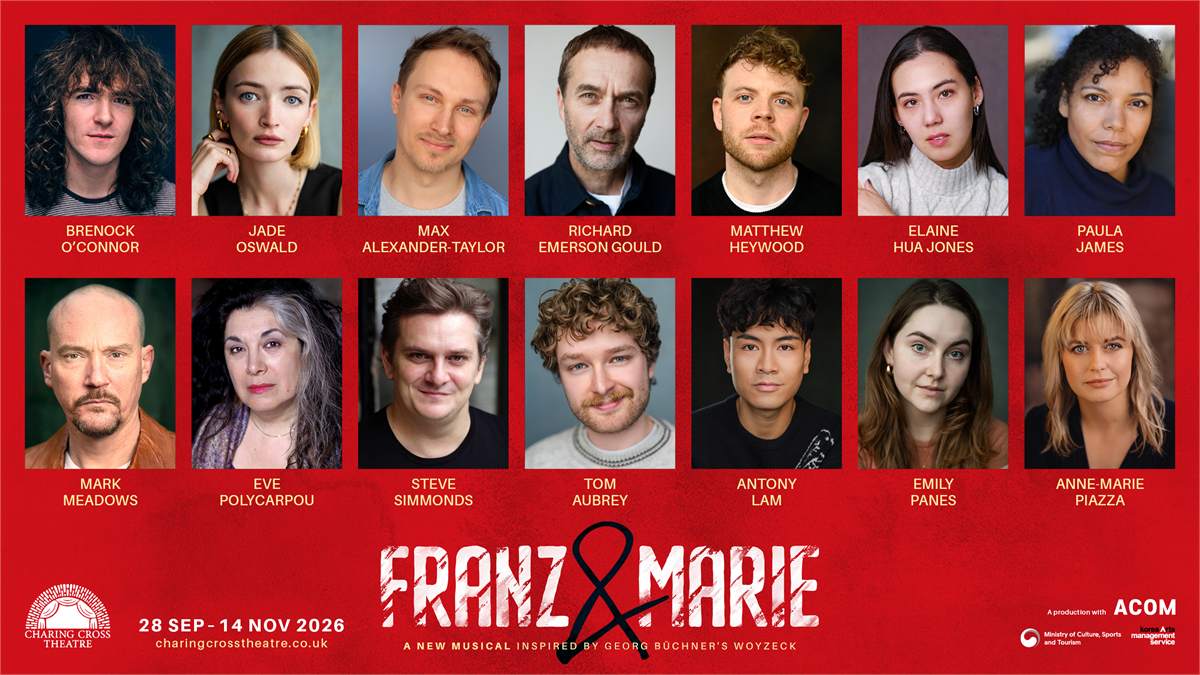
Brenock O'Connor plays Woyzeck. Screen audiences will know him from Game of Thrones, Alex Rider and Derry Girls. Opposite him, Jade Oswald plays Marie, having appeared in Little Women on tour and at Salisbury Playhouse, in Treason The Musical in concert at the Theatre Royal Drury Lane, and in Stephen Sondheim's Old Friends.
They lead a company of 14 actor-musicians, which means the people telling the story are also the band. Steve Simmonds plays Sergeant Ursid, Paula James is Zella, Richard Emerson Gould is Doctor Simian, Matthew Heywood is Drum Major Varg, Max Alexander-Taylor is Andre Schmitt, Mark Meadows is Captain Peccary, Eve Polycarpou is Vashti and Elaine Hua Jones is Kat. The ensemble is completed by Antony Lam, Anna-Marie Piazza, whose credits include War Horse, Emily Panes, who appeared in The Curious Case of Benjamin Button, and Tom Aubrey, who makes his professional stage debut.
What is Franz & Marie about?
The source is Georg Büchner's Woyzeck, a play left unfinished at the author's death in 1837 and staged ever since in whatever order its editors prefer. The setting here is a war-torn corner of late nineteenth-century Europe, where a platoon of young soldiers has been stationed at an isolated outpost for months without further orders.
Franz Woyzeck has come back from the front with nightmares he cannot shake. He lives for two people: Marie, his girlfriend, and Georgie, their baby. To earn a little more money for them, he submits to medical experiments run by the army doctor. Poverty, humiliation and the demands of the men above him close in, and the small world the couple have built begins to come apart.
What separates this version from most is where it puts Marie. Büchner's original centres on Franz; this adaptation gives her equal prominence and pairs the two in the title, much as Romeo and Juliet are paired. The show is recommended for ages 12 and over.
Who is behind the production?
Michael Oakley directs, with choreography by Ben Wright. Book and lyrics are by Chris Broderick, with music by Rob Shepherd and Chris Broderick, and the new adaptation is by Teresa Howard. Steven Edis provides additional music, arrangements and orchestrations.
The score's history explains a great deal about how the show sounds. Broderick and Shepherd are both members of the Medway band The Singing Loins, and their version of Woyzeck was commissioned by the Korean musical theatre company Acom and staged at the LG Arts Center in Seoul in 2014. It has been reworked as Franz & Marie for this run, which Acom produces with Charing Cross Theatre Productions. The result is an indie-folk score rather than a conventional musical-theatre one - closer to a band playing a tragedy than to an orchestra accompanying it.
When and where can I see it?
Franz & Marie opens at Charing Cross Theatre on Monday 28 September 2026 and is booking until Saturday 14 November 2026. Tickets currently start at £25, though that figure tends to move as a run fills up. The theatre sits underneath the arches beside Charing Cross station, which makes it one of the easier London venues to reach.
What else should I book if I like it?
If the draw is a folk score carrying a myth, Hadestown does the same job with the Orpheus story and a stage band in plain sight. If it is nineteenth-century Europe, poverty and soldiers, Les Misérables remains the definitive version of that world. Cabaret shares the taste for decadence curdling into menace, and for a company that plays as well as acts. And for a classical tragedy rebuilt for a modern audience, The Oresteia at the Bridge Theatre is the closest current parallel to what this adaptation is attempting.