Audiences in Portugal, Germany and France have stormed the stage, shouted the actors down and thrown fruit. At the Dorfman, they coughed. Catarina and the Beauty of Killing Fascists is Tiago Rodrigues’s 2020 play about a Portuguese family who kidnap and shoot a fascist every year, and it has arrived at the National Theatre for a single week, performed in Portuguese with English surtitles. The notices are in, and they cluster tightly around two things: the half-hour far-right speech Romeu Costa delivers at the close, which every critic writes about, and the 150 minutes without an interval that lead to it. Where they part company is whether that endurance is the point of the evening or its problem – and, quietly, whether a London press night that sat politely through the whole thing proves the play’s case or undermines it.
The verdict: fifteen reviews in so far, ten of them carrying a score – four four-star notices, five three-star and one two-star, an average of 3.3 out of 5. The other five either publish no rating or sit behind a paywall without showing one. Almost every critic writes about Romeu Costa’s closing speech, and almost as many about the 150 minutes without an interval that precede it; the rest of the company, led by Isabel Abreu and Beatriz Maia as mother and daughter, is praised across the board.
What are critics saying about Catarina and the Beauty of Killing Fascists?
Time Out
“Tiago Rodrigues’ weird, troubling satire about the moral questions of our age is bracingly powerful stuff”
Reviewer: Tim Bano
“Although a bonkers setup, Rodrigues uses it to argue all of society’s divisions in astonishingly comprehensive, astute and often very funny ways. It’s stuffed full of quotable lines about justice vs revenge, courage vs cowardice, when to call a spade a spade or a fascist a fascist. Rodrigues whips up that old argument about the limits of tolerance (should we even be tolerant towards actual Nazis??). It’s a super-smart bit of writing and, at the same time, with a character who constantly quotes Brecht and a blazing final speech from that speechwriter, it warns strongly against looking for answers in mere rhetoric.”
London Box Office
Reviewer: Stuart King
“As a warning against the pitfalls inherent in the over simplification of the human experience through generalised ideologies, it makes a potent argument. Certainly the final hectoring speech by the politico who is ultimately freed from captivity, speaks to the jingoistic fervour and disturbingly simplistic rallying of whole sections of society under a banner. Such notions proclaim patriotic identity, alongside disgust and intolerance towards minorities in all their guises, while simultaneously espousing adherence to religious doctrines which perpetuate misogyny, domestic abuse and intolerance of migrants. As you can imagine there was a lot of muttering and awkward shifting in seats.”
LondonTheatre1
Reviewer: Chris Omaweng
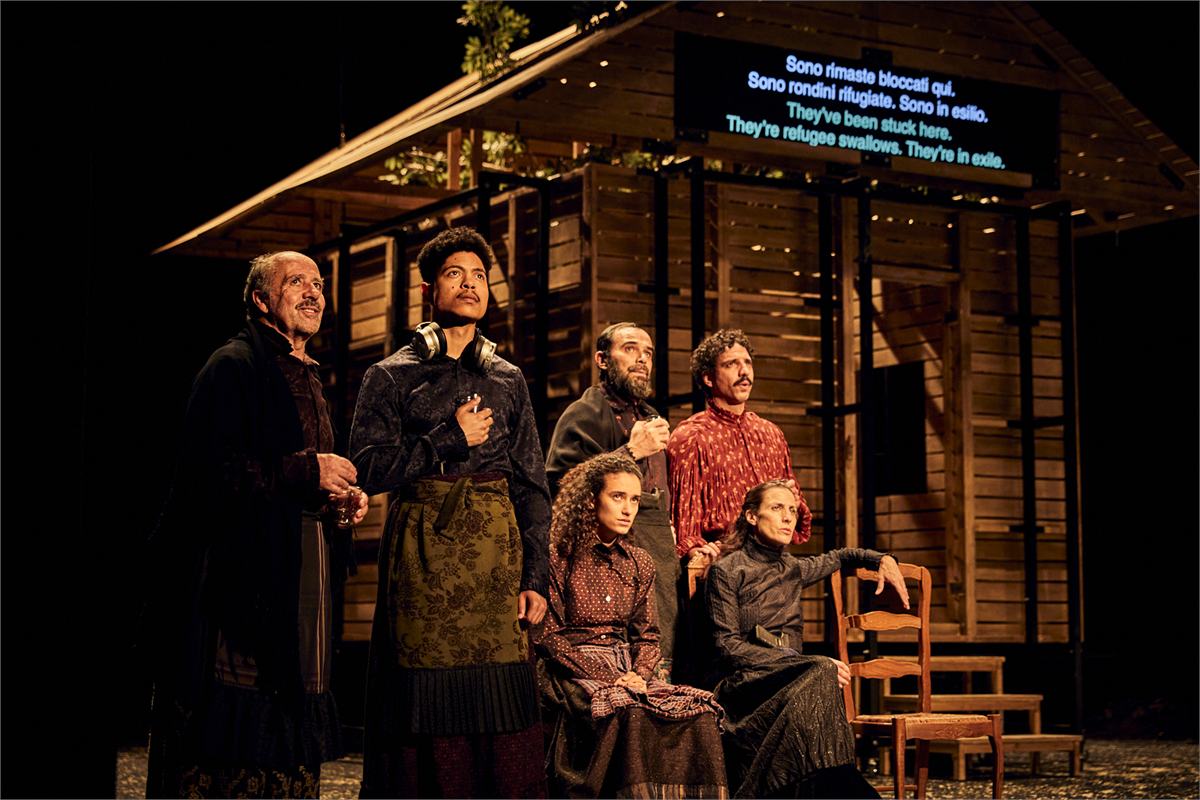
“It wasn’t wall-to-wall fascism and anti-fascism – there was talk of swallows (the play could have done better to explain the bird’s symbolic meaning in Portuguese culture), veganism (the annual fascist killing ritual involves a family feast) and the notable works of Bertolt Brecht. The humour in the play is, as one might expect given the subject matter, sometimes very dark indeed, but also, given the subject matter, very much needed. It’s not didactic – there’s nothing to suggest there is a definitive way to combat fascism. In a hurried and harried world, this production is nuanced, unsettling and thoughtful.”
All That Dazzles
Reviewer: Daz Gale
“Rodrigues’ writing is fascinating for the harsh and unfiltered way it presents the scenario. The word provocative really is the best way to describe it, as the play deliberately tries to cause a response from the audience. Starting fairly inoffensively as the gathered family argue about the meal being presented and whether it competes with their late mother’s, the first sign of disagreement and debate within the family comes with the argument about veganism, in a fairly comedic way. Once Catarina emerges, the severity of the situation becomes apparent, and the tone starts to veer from lighter moments to much darker ones.”
The Guardian
“It caused fury across Europe. In the UK? Laughter and coughing”
Reviewer: Arifa Akbar
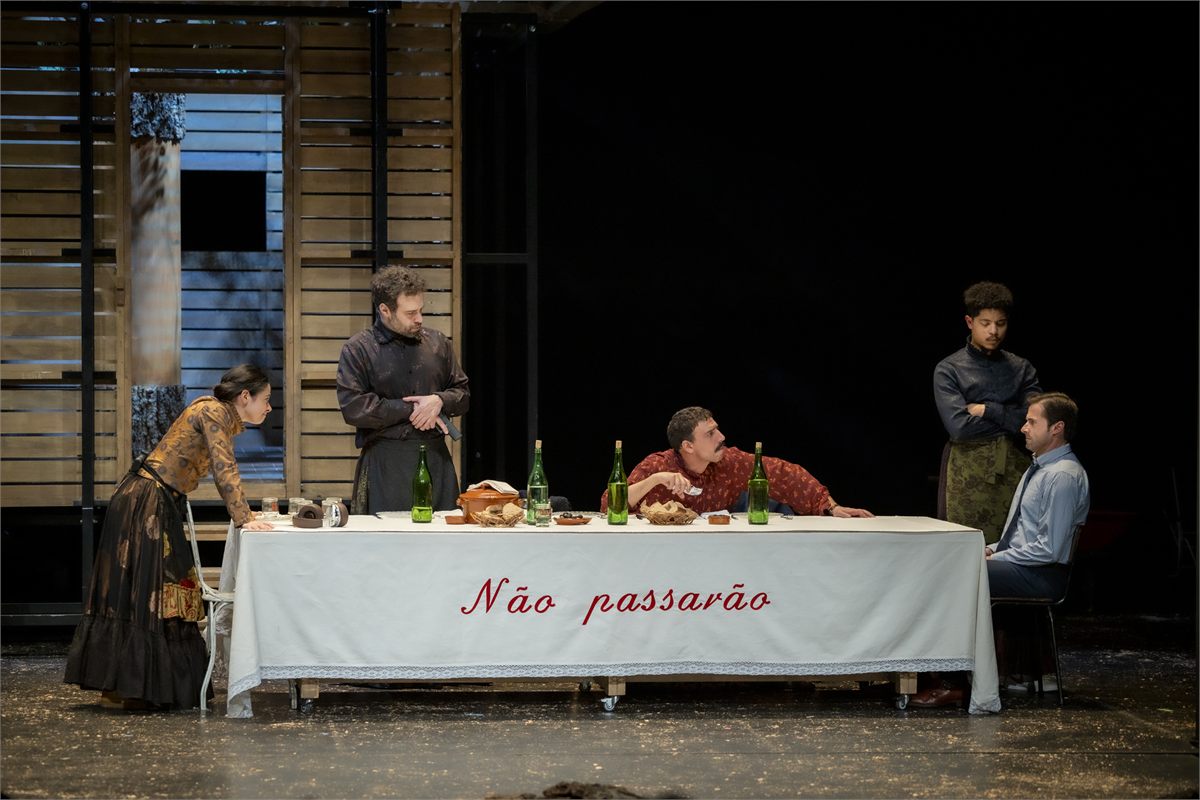
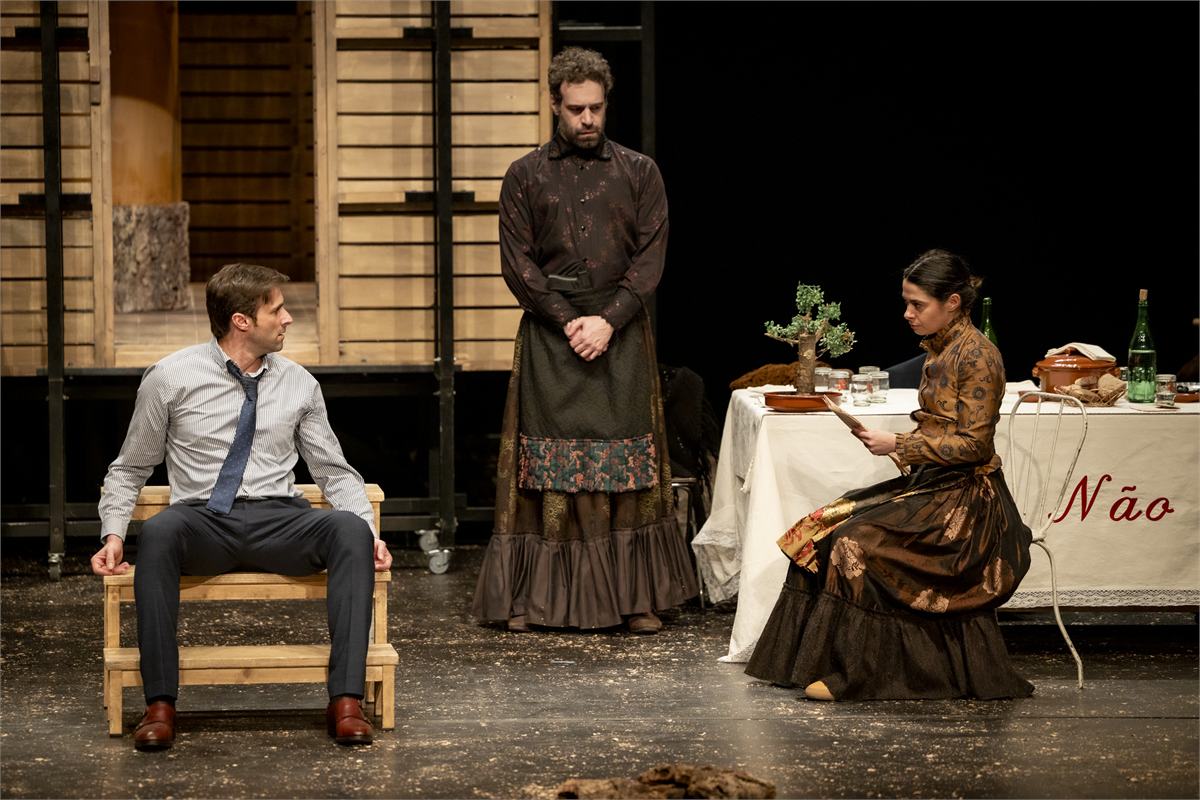
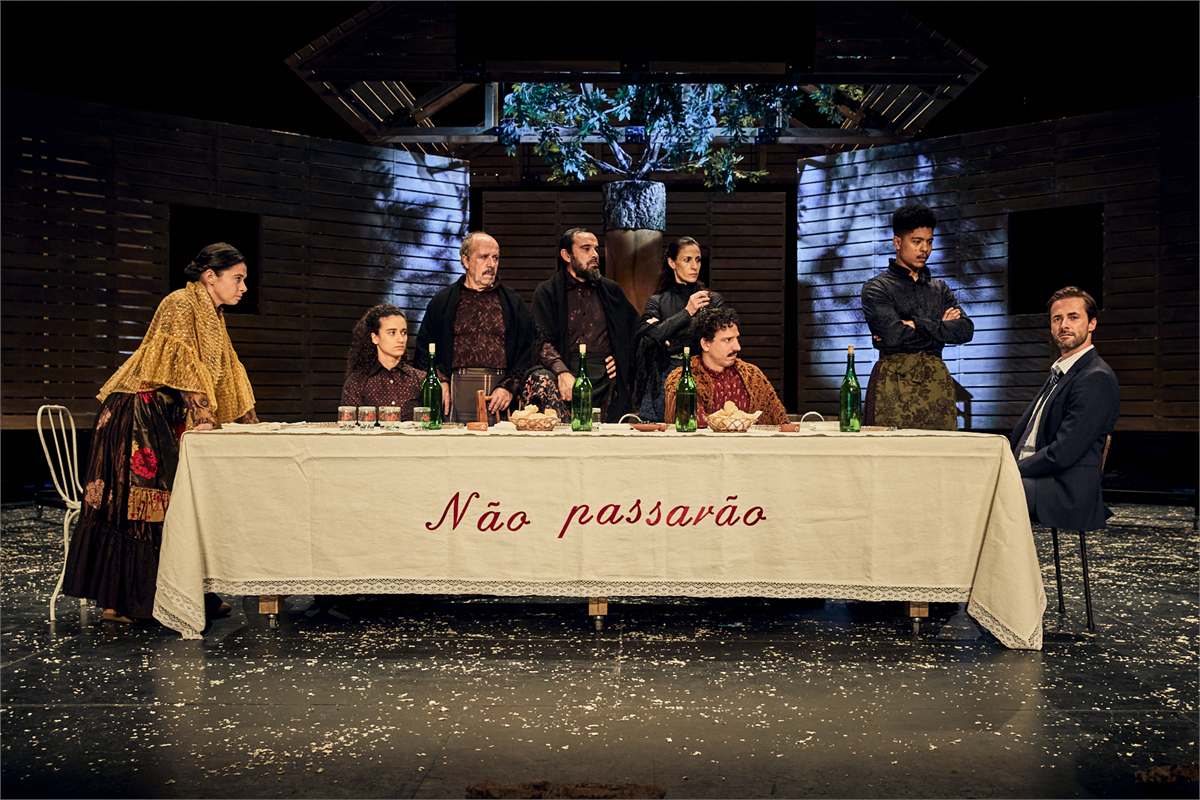
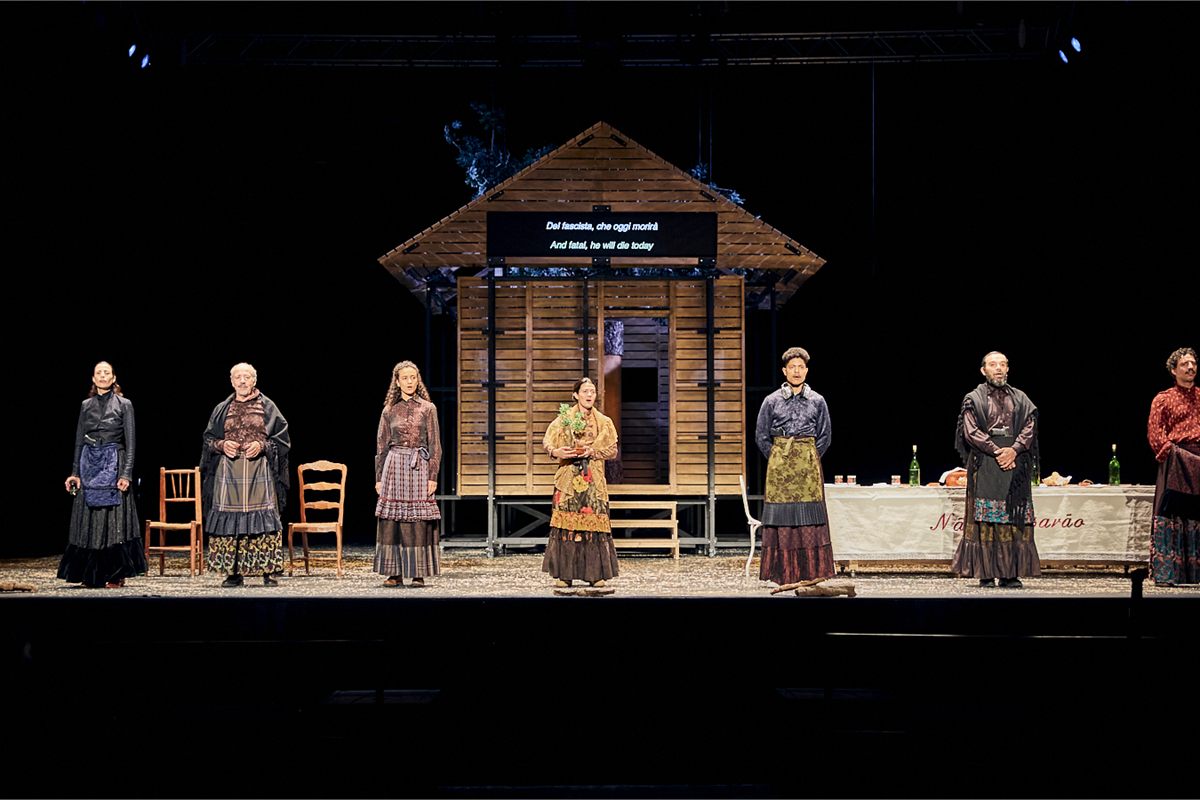
“So it is arduous to watch, in spite of Fernando Ribeiro’s origami-like set of a slatted house, foregrounded by a dining table reminiscent of The Last Supper, that rearranges itself beautifully. Then, suddenly, the crushing boredom is punctured by the shock of gunfire and the politician’s speech. Have we been deliberately lulled into an almost soporific state?”
WhatsOnStage
Reviewer: Sarah Crompton
“You are meant, I think, to walk out; to scream, shout and whistle, storm the stage in protest. That’s what has happened as Tiago Rodrigues’ unsettling parable has played in theatres across the world since its premiere in 2020. On press night, the British audience let out the odd whistle and wriggled uncomfortably. But they mainly laughed as a populist politician took to the stage and spewed his message of hate. Which might say something about how hard it is to fight extreme opinions with tolerance. Or it might simply describe just how difficult it is to subvert the conventions of theatre to provoke a response.”
London Theatre
“this Portuguese import is urgent and provocative”
Reviewer: Anya Ryan
“All of that said, the play is a bit of a slog: at two hours and 30 minutes without an interval – with an uninterrupted hate speech to finish things – you’re pretty much gagging to get out by the end. In an age packed full of polarising opinions, perhaps that space is needed, but in the middle section the play’s spiky bite dissipates. Still, this remains urgent, provocative stuff – exactly the sort of thing the National should be programming.”
The Reviews Hub
“Deeds Not Words”
Reviewer: Richard Maguire
“All the Catarinas are fully-formed characters, with João Vicente’s nascent capitalist Catarina a particular delight. Marco Mendonça’s Catarina seems permanently broken by the ritual, wearing noise-cancelling earphones, and there is some electric dialogue between the doubting Catarina and her mother (Beatriz Maia and Isabel Abreu). Bringing on the smarmy rhetoric is Romeu Costa, the right-wing politician awaiting his fate.”
theartsdesk
“Provocative if also heavy-handed Portuguese drama pays a welcome visit to London”
Reviewer: Aleks Sierz
“Rodrigues first exhausts the audience by the sheer length of the play, and its constant shifts in argument as the family seeks to persuade young Catarina to do the beautiful killing, then hammers home his point that far-right ideology is revolting. It’s very effective, but also very crude. And kind of pointless. I mean, do we need to be lectured about the evils of the far-right? Who changes their mind after being punched in the head? Bang.”
BroadwayWorld
“Celebrated and controversial Tiago Rodrigues’ play is demanding and rewarding”
Reviewer: Gary Naylor
“Tiago Rodrigues’ searing, coruscating, appalling Catarina and the Beauty of Killing Fascists, given its UK premiere at The National Theatre (which is exactly what it should be doing) provoked these reflections, and a terrifying kaleidoscope of other intrusive thoughts, insistently bubbled up while I was trying to watch the play. If the script occasionally threatened to dissolve into an overheated Oxbridge undergrad philosophy seminar - at one point, it did, but it was funny rather than tedious - the sledgehammer of its language (translation by Daniel Hahn) and the strength of the ensemble cast, maintained its extraordinary theatricality. Yet still those thoughts jabbed at my mind.”
West End Best Friend
Reviewer: Beatriz Ferreira
“The message is clear, but deliberately inconsistent. That’s the point. The arguments feel incredibly lived-in because nobody is simply right and nobody is simply wrong. Catarina is justified in her questions. Her mother is entirely believable in her answers. Both have experienced censorship at different levels, and they are, in many ways, the same, and yet profoundly different.”
Also reviewed by: The Telegraph (Dominic Cavendish, two stars, “Incendiary? This fascist-platforming play is a damp squib!”), The Times (Clive Davis, “tedium in Portuguese”), The Stage (Neil Norman, “Metaphors trample over dramatic subtleties”) and the Financial Times (“the Portuguese play that has provoked walkouts and stage invasions”), whose reviews sit behind paywalls. Only the Telegraph shows a score on its public page; the other three do not.
For more of what the critics have been saying this week, our Crime and Punishment roundup gathers the notices for the Jack Studio Theatre revival, and our Turn of the Screw roundup does the same for the Arcola.
Catarina and the Beauty of Killing Fascists is booking at the Dorfman - National Theatre until Saturday 26 September 2026.