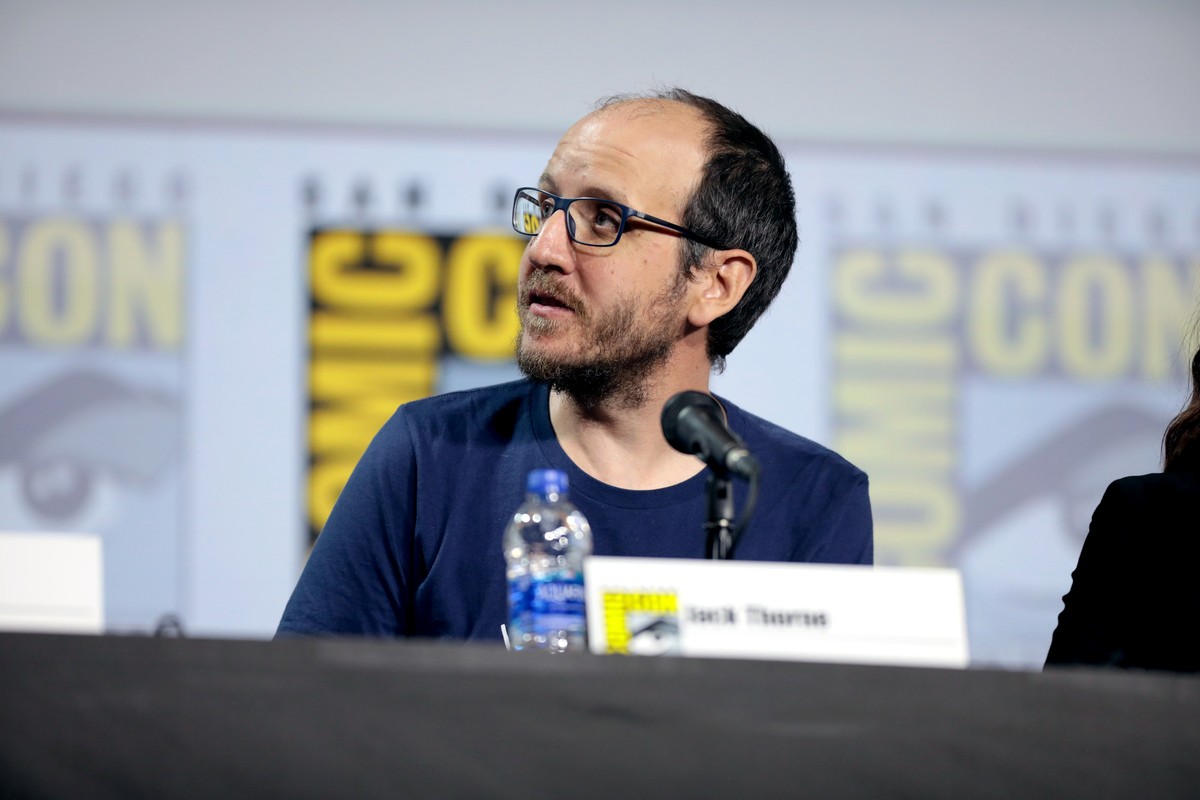
 Jack Thorne used a speech at the Queen Elizabeth Hall on Sunday to set out five things he wants the Government to do about AI and writers. Four of them are plausible, one has already been won by contract rather than statute, and the history of the player piano suggests what winning would actually look like, and what it would not.
Speaking at the Queen Elizabeth Hall on Sunday evening, at an event on authorship in the age of AI, the Writers’ Guild president Jack Thorne told the room that writers “are facing our moment of enclosure”. It is a deliberate phrase, and it is worth pausing on, because the history it invokes runs the other way.
Enclosure took a commons and made it private. Common land was fenced off, by landowners and by Acts of Parliament, and the people who had worked it lost rights they had held for generations. What Thorne described on Sunday is the inverse: private work dragged out into a commons without its owners’ consent. Those are opposite injuries, and they call for opposite remedies. You resist enclosure by asserting a right of access. You resist unauthorised commoning by asserting a right to be paid. The rhetoric points one way; the five proposals he then set out point firmly the other, and they are the better guide to what he actually wants.
They are not equally achievable. Taken in order of how easily each could be done, rather than the order he gave them, the picture is clearer.
The Copyright Institute is the easy one. Thorne wants a body to sit alongside the Government’s AI Security Institute: “A regulatory body that monitors and regulates AI expansion and suggests Government intervention, if necessary, in the market”. Institutions of this kind can be stood up quickly, and the precedent is recent. The question is what powers it would carry. A regulator that monitors and suggests is a research body with a letterhead; one that can set rates or bring enforcement is something else entirely, and nothing in the speech says which is intended.
Transparency is already happening, and is already weak. Thorne’s complaint is that big tech “steal, but because they don’t have to declare where they stole from, the stealing goes unpunished”. This is the proposal with a live model: under the European Union’s AI Act, providers of general-purpose AI must publish a summary of their training content and adopt a policy for complying with copyright law. The UK would be following rather than inventing. The limitation is not legal but forensic. A declaration regime polices the honest; there is no reliable way to prove from the outside that a particular book sat in a particular training set, which means a disclosure duty is only as good as the disclosure.
The fraud proposal is the most quotable and the least necessary. Thorne would change fraud legislation so that passing off machine-generated work as your own is an offence: checking “your spelling and sense” would stay lawful, but “if you use AI to generate content and you do not declare it as such then that is fraud”. The striking thing is that the industry has already achieved the substance of this without troubling Parliament. The agreement that ended the 2023 Writers Guild of America strike, after 148 days, prohibits the exploitation of writers’ material to train AI models and restricts the use of AI to cut writers or their pay. Contracts can require a warranty; publishers and producers can enforce it commercially.
Making it criminal is where the difficulty starts, because a fraud case needs evidence, and the available evidence would be AI-detection software. Those tools are unreliable, and their false positives fall hardest on writers whose first language is not English. Thorne’s own carve-out shows the problem in miniature: the line between using a machine to check your sense and using it to generate your content is obvious in the two extreme cases and almost impossible to draw anywhere in between.
The pricing proposal is the one that would matter, and the one with no precedent at the size required. Thorne wants the texts used in training to generate a cost, and he is specific about how large: “These costs need to be large enough that generating ideas through machines isn’t necessarily cheaper than generating ideas through humans.” Collective licensing is a well-understood mechanism and the industry has run versions of it for a century. But licensing sets a price for access. It has never been used to set a price calculated to make a competing technology uncompetitive. That is a tariff with a licence’s name on it, and it would be argued about on those terms.
The impersonation proposal is the hardest, and it cuts towards writers as well as away from them. Thorne described asking Gemini “to write a script in the style of Craig Mazin, no other prompts just that, it did and it wasn’t good but there were aspects of his writing I recognised”. The obstacle is foundational: copyright protects the expression of an idea, not the idea, and style has never been ownable. Creating a right against stylistic imitation would mean creating a new kind of property, and it would reach a long way. Theatre in particular runs on pastiche, homage and the deliberate echo; every writer alive learned by imitating someone. A rule drawn tightly enough to stop a model producing a Mazin pastiche is a rule that a living writer could be accused under.
So: is any of it possible? The best answer is a precedent Thorne did not cite. In 1908, in White-Smith Music Publishing v Apollo, the United States Supreme Court held that piano rolls were not copies of sheet music. They were parts of a machine, and no human could read them, so the manufacturers owed composers nothing. The parallel is exact: a machine consumes a work, produces output, and the law finds that no copy was made.
Congress reversed it the following year. The Copyright Act of 1909 created the first compulsory licence in American copyright law — you may reproduce the work, but you must pay a set rate — and the mechanism generalised to records and outlived the player piano by a century. It is, almost exactly, Thorne’s second proposal, and it took about a year.
That is the encouraging half. The sobering half is what it actually achieved. The player piano was not slowed down, discouraged or regulated out of the market. It was made to pay. “Made to pay” and “held back” are different outcomes, and a speech that asks for pricing set high enough to protect human work is asking for the second while pointing at a precedent that delivered the first.
The part of the speech that belongs to theatre came near the end, and it was not about legislation at all. Thorne traced Michaela Coel’s route into television: Chewing Gum Dreams at the Yard, a fringe room in Hackney, then the National Theatre’s temporary space, then Channel 4, where it became Chewing Gum, and from there the BBC commission that produced I May Destroy You.
“Every stage of that process required investment, investment from actors, directors, designers, producers and enthusiasts,” he said. “If a Michaela Coel script can be digitally created, then that investment becomes less interesting. If Michaela Coel can be scraped and those scrapes can be used to create shadows of her work, can be used to create a Michaela Coel substitute, then the investment in the next Michaela Coel becomes less likely.”
That is the argument with the sharpest stake for this industry, and it is the one least likely to be quoted elsewhere. It says that writers are not found, they are made, and that they are made in small theatres by people taking an unreasonable financial risk on an unknown. None of Thorne’s five proposals addresses it directly. A licensing regime pays for work already written; it does nothing to fund the room above the pub where the next one gets written. If the pipeline is the thing genuinely at risk, the remedy is subsidy and commissioning rather than copyright law — which is a harder argument to make to a government, and a much harder one to fit into a headline.
“AI, in its current form, is a shrinking tool,” Thorne said. “And it doesn’t need to be. We do not wish to be shrunk.”
Thorne’s speech was delivered on Sunday 13 September and reported in full by the Writers’ Guild of Great Britain. Read the WGGB’s account of the address.
Photograph of Jack Thorne by Gage Skidmore, used under a CC BY-SA 2.0 licence.