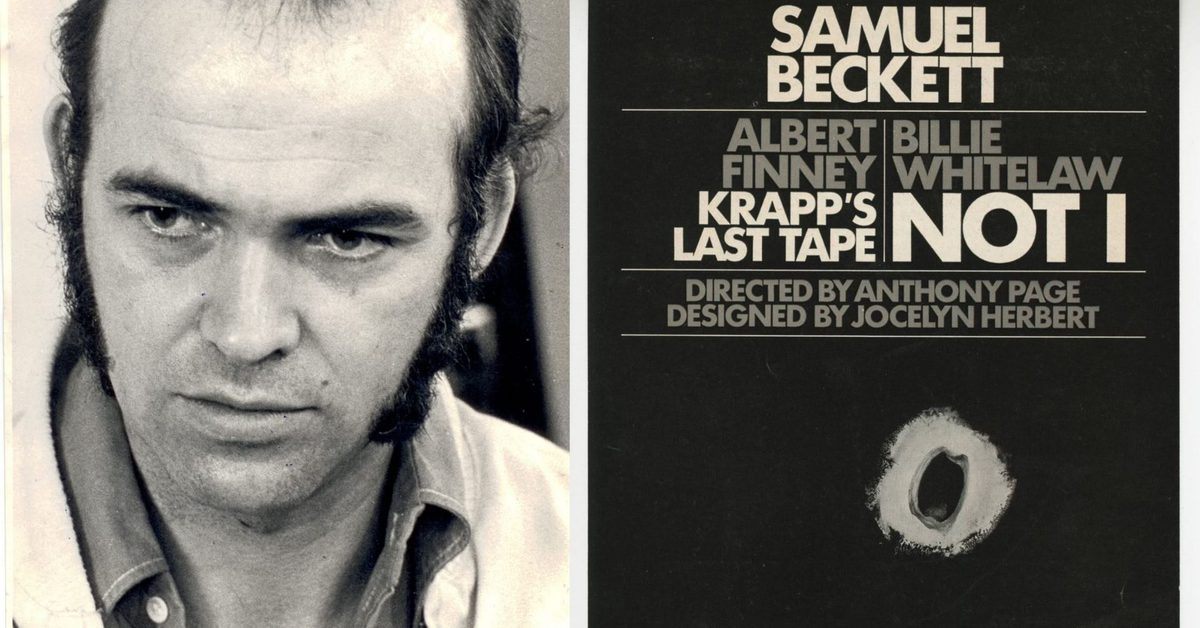
 The director Anthony Page, who led the Royal Court through its battles with the Lord Chamberlain and later won a Tony Award on Broadway, has died at the age of 90.
Anthony Page, who took charge of the English Stage Company when its founding artistic director fell ill and who went on to share the leadership of the Royal Court Theatre, has died at the age of 90.
He died on Friday 11 September at Denville Hall, the residential home for people who have worked in the performing arts, and his death was announced this week by his press representative. He is survived by his husband of forty years, Kenneth Butler. A private cremation will be followed by a memorial next spring at St Paul’s, the Actors’ Church in Covent Garden.
Page was born in Bangalore in 1935, the son of a brigadier general in the British army. He read English at Oxford and then trained in New York under the acting teacher Sanford Meisner, and it was there that he met Tony Richardson, who invited him to the Royal Court. He joined the theatre as an assistant director in 1958, two years after the English Stage Company arrived in Sloane Square, and he remained closely associated with the building for the next fifteen years.
When George Devine, the company’s founding artistic director, fell ill in 1964, it was Page who stepped forward to take on the artistic leadership. His production of John Osborne’s Inadmissible Evidence, with Nicol Williamson in the central role, was a considerable success and transferred to the West End, beginning a working relationship with Osborne that lasted for years.
The production that mattered most to the theatre’s own history came the following year. The Lord Chamberlain would license Osborne’s A Patriot for Me only with substantial cuts, so the Royal Court reconstituted itself as a private members’ club and played the text uncut on the grounds that the performances were not public ones. It was the opening move in the campaign that ended state censorship of the English stage three years later.
Page’s other sustained collaboration was with Samuel Beckett. He directed the first British revival of Waiting for Godot, again with Williamson, and in 1973 the British premiere of Not I, in which Billie Whitelaw’s mouth, lit and suspended in total darkness, became one of the defining stage images of the twentieth century. Page was thirty when the two men began working together and Beckett was sixty. “He was full of humour,” Page said of him. “We enjoyed working on it with him.”
From 1969 to 1972 he shared the artistic directorship of the Royal Court with William Gaskill and Lindsay Anderson, the last of his fifteen years at the theatre.
He was also the director Edward Albee turned to most often, staging six of his plays on Broadway, in the West End, at the Almeida and at the National Theatre. On Broadway he directed Heartbreak House with Rosemary Harris and Rex Harrison, Cat on a Hot Tin Roof with Ashley Judd and Jason Patric, Who’s Afraid of Virginia Woolf? with Kathleen Turner and Bill Irwin, and the 2009 revival of Waiting for Godot with Irwin and John Goodman. His A Doll’s House with Janet McTeer won him the Tony Award for Best Direction of a Play in 1997.
His later London work included Who’s Afraid of Virginia Woolf? and Long Day’s Journey into Night, with David Suchet and Laurie Metcalf, both at the Apollo, and Design for Living at the Old Vic with Tom Burke, Lisa Dillon and Andrew Scott.
Screen work occupied much of the middle of his career. He was invited to the United States in 1973 to direct his first television film, Pueblo, which won five of the seven Emmy Awards for which it was nominated, and he went on to make more than thirty-five further films for cinema and television. Among them were I Never Promised You a Rose Garden, The Lady Vanishes and, in 2008, My Zinc Bed. The best known remains his BBC adaptation of Middlemarch, broadcast in 1994.
“Anthony Page was one of the pioneering theatre directors of his time,” David Hare said. “On George Devine’s death he took over the artistic directorship of The Royal Court Theatre and ensured its survival. After outstanding stage productions of writers like Albee, Beckett and Osborne, he later mastered television drama, most especially to create an unforgettable Middlemarch. Great actors like Paul Scofield and Maggie Smith trusted him completely, because he was thoughtful, kind and sensitive. What a loss!”
The producer Nica Burns, who presented three of his later productions, said: “He was the most delightful man with a towering intellect and an extraordinary ability with the text. I would have loved to have done more work with him. He was very happy in his private life - Anthony and Ken, his husband of 40 years, were a delightful, loving couple. He will be much missed.”
The Royal Court, in its own tribute, called him one of the defining directors of its early history and said he belonged to “the generation that established the blueprint for what a writers’ theatre could be, and how directors could best put themselves at the service of that vision”.
That work goes on in Sloane Square this winter: Rhys Warrington’s Monument, whose company was completed this month, opens in the Jerwood Theatre Upstairs on Thursday 3 December 2026.