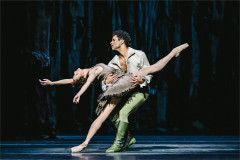
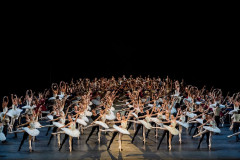
Mere Mortals has opened Sadler’s Wells’ autumn season, and it is San Francisco Ballet’s first London visit since 2019 — the company now under Tamara Rojo, in a seventy-minute piece choreographed by Aszure Barton to a live score by Floating Points that retells the Pandora myth as a warning about artificial intelligence. The critics are united on the dancing: the forty-strong corps, Wei Wang’s Hope and Jennifer Stahl’s Pandora draw admiring notices from every outlet, and the meeting of synthesiser and orchestra is the evening’s most-praised element. Where they divide is on the story, and on the spectacle wrapped around it. The Reviews Hub calls it ballet from the future; theartsdesk finds the narrative as murky as the lighting, Gramilano finds a production that shocks so hard it alienates, and more than one reviewer felt Hamill Industries’ screens pulling focus away from the dancing.
The verdict: thirteen reviews in — one five-star notice, four at four, one at three and a half, three at three, and four outlets that publish no rating. The nine that score it average 3.7 out of 5. The ensemble of more than forty dancers and Floating Points’ live score are praised in every single one; what splits the critics is whether the Pandora story survives being turned into a parable about artificial intelligence.
What are critics saying about MERE MORTALS?
The Reviews Hub
Reviewer: Richard Maguire
“Only one thing is left behind in Pandora’s box and that is Hope, and it is Hope (Wei Wang in a rubber suit) who appears on the stage first, bathed in red light with a huge quantity of dry ice swirling around him. It’s the first of many arresting images in this 80-minute show. As the live orchestra play Floating Points’ eclectic score, the initial sounds similar to an aeroplane taxiing on the runway, Wang begins to dance. A tempo finally appears from the pit, but Wang hits none of its beats, even when the drums begin a rapid machine-gun fire.”
West End Best Friend
Reviewer: Chris Abbott
“Perhaps the most impressive part of the ballet was the dancing of the ensemble, all forty of them mostly moving in unison, edging downstage towards the audience, mutating like the images on the screens or seizing a character, and propelling him or her to the heights from the hill they formed with their bodies.”

London Box Office
Reviewer: Eve Jawara
“The principal characters Prometheus (Joseph Walsh), Pandora (Jennifer Stahl), Epimetheus (Harrison James) and Hope (Wei Wang) were outstanding, both in their dancing and their acting. The pas de deux between Pandora and Epimetheus was especially beautiful to watch and was a tender juxtaposition to the powerful movement in Prometheus’ scenes.”
Theatre and Tonic
Reviewer: Cathie
“In this 70 minute journey into the world of Pandora’s jar we see beautifully stunning choreography by Aszure Barton. In a mix of sharp staccato movements and flowing ethereal sequences the show starts with Hope (Wei Wang) dressed in black and exploring the depths of the box. In a following multitude of seamless solos and group dances we meet three other significant characters from the Hellenic myths, also daring to defy the Gods and forge new paths for humanity. Brothers Prometheus and Epimetheus, (portrayed by Joseph Walsh and Harrison James) showcase the perils, toils and pain of themselves as well as all of humanity amongst the newly unleashed evils. Finally, weaving her way so beautifully in and out of the other dancers is Jennifer Stahl as Pandora. Her fluid and powerful movements are so precise and nuanced that she creates a world of layered depth in the doomed woman.”
The Spy in the Stalls
Reviewer: Nasia Ntalla
“The large ensemble is one of the production’s greatest strengths. With 40 dancers, their collective movement creates an extraordinary sense of scale and, at times, doom. They become almost one organism, which is particularly effective within the production’s exploration of technology, conformity and the loss of individuality.”

BroadwayWorld
Reviewer: Franco Milazzo
The trouble is the myth keeps losing the fight. Strip away the synopsis in the programme notes and you’re watching gorgeous, well-drilled dancers do something to do with technology and catastrophe. Wayne McGregor solved a near-identical problem in Autobiography by letting the structure itself be generated by an algorithm, presenting form as argument. Barton’s form is spectacle as mood board, gestured at rather than built.
This all leaves Mere Mortals in the odd position of proving its own thesis by accident: humanity keeps building magnificent new machines and never asks whether their latest invention is more dangerous than it is worth. Zeus never explained the box either. At least he had the excuse of being a god with better things to do.
LondonTheatre1
Reviewer: Fiona Gilbert
“There is no denying that this is a spectacular production that unleashes an array of artistic forms at the audience: orchestral music, industrial electronica, art-house videography and vibrant, if sometimes repetitive, dance moves. At times it is intense, at others entrancing, as much a sensory experience as a dance show. The combination means this may not be a ballet that will appeal to everyone, but given the company’s stated aim to fuse movement, music and visuals into a spectacle that demands attention, it undeniably succeeds.”
theartsdesk
“The Pandora myth makes an underwhelming vehicle for the dangers of AI”
Reviewer: Helen Hawkins
“Accompanying the piece is a score by Floating Points (aka Sam Shepherd, present in the pit playing a Buchla and other electronics), which melds electronica with regular orchestral sounds from strings, brass and the like. The combination of this score with Hamill Industries’ visuals – presumably the source of the AI in the piece? – is arresting at times, but overall makes for an oppressive evening. The mood only lifts when a golden Hope reappears for the finale, like a supple Oscar statuette. Perhaps repeat viewings would illuminate matters. The dancers are worth it, an athletic, well drilled troupe with outstanding soloists, especially Wang and Stahl. I'd like to see them put through their paces in other work. But this piece fails to meet the expectations set up for it.”
Gramilano
“It shocks so much that it alienates”
Reviewer: Lucía Piquero
“Giving choreographer Aszure Barton the first full-length commission in the company for a female choreographer is already a statement; doing it with a work about AI, based on a Greek myth that discusses humanity’s evils, is a proper punch. The live music of Floating Point adds the final touch to something that would ordinarily have been a sensational performance, in all its meanings. Unfortunately, it “shocks” so much that it alienates, and I found myself wondering why we were watching this several times through the night.”
British Theatre Guide
Reviewer: Vera Liber
Production design by Hamill Industries dominates the stage—the dancers small and insignificant against the many screens behind them (approximating Cinerama, I think), as indeed we are in the universe. For me, it is music by Floating Points that dramatises and propels the narrative, such as it is, and the amazing dancers, so supple and regimented—with not a pointe shoe in sight.
Seeing Dance
Reviewer: David Mead
The dancing is powerful, the ensemble injecting a sense of great scale while the central duet provides a moment of calm. As befits a work inspired by technological developments. the backing projections by Hamill Industries are impressive. They compete with but never quite overpower the dancers. The score by Sam Shepherd (aka electronic music artist Floating Points) is terrific, at least once it gets past the opening persistent, high-pitched droning.

Production photographs by Chris Hardy and Jane Hobson.
Also reviewed by: The Stage (Siobhan Murphy, four stars, “Arresting surprises”) and The Observer (Sarah Crompton, “AI meets Pandora’s box in San Francisco’s chilly spectacle”), whose reviews sit behind paywalls.
For more of what the critics have been saying this week, our recent roundups cover Kimberly Akimbo at Hampstead Theatre and Still Life at the Theatre Royal Drury Lane.
San Francisco Ballet: Mere Mortals runs at Sadler’s Wells until Saturday 12 September 2026. It lasts a little over an hour and is performed without an interval.